Blue Fang Skeleton Tarantula (Ephebopus cyanognathus)

Ephebopus, New World 3 Comments »

The Blue Fang Skeleton Tarantula commonly known as just the Blue Fang is a deep burrowing terrestrial tarantula from French Guiana but also commonly found in Suriname and Guiana. This New World species is loved due to its skeleton like markings on its legs and of course its “blue fangs” which is actually the metallic to neon blue coloring of the chelicerae and not the actual fangs (spoiler alert the fangs are actually just black). In addition they have a nicely colored carapace and abdomen which tends to be a nice coloring of green to yellow. They are hardy and slow growing but live for a very long time.
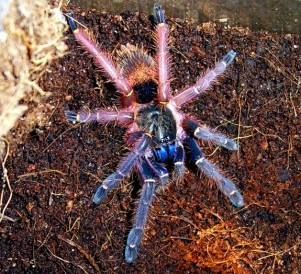
 

e.cya


Habitat:

The Blue Fang is a known pet hole. Your tank should contain a deep substrate for it to burrow in. preferably 4 to 6 inches. As for tank size the most you will need will be about 5 gallons. This species requires very high humidity and a very damp substrate is recommended. Due to the amount of humidity we would recommend a coconut fiber mix as this is acidic and will help in preventing mold in the tank. is You can also set up a hide/retreat though not recommended being that chances are it will never use it. A steady temperature of 77 to 83 degrees should be ideal and a humidity of about 75 to 80 percent. As always a clean over-filled water dish should always be readily available to keep your tarantula properly hydrated.


Feeding:

The Blue Fang Skeleton Tarantula is an excellent eater and should be fed once a week. Being an insectivore, a steady diet of nutritious live crickets, cockroaches, locusts, moths and even meal worms should be fine to keep your tarantula well fed and happy.


Attitude:

Though new world the blue fang is known for sometimes having a nasty attitude. They are extremely fast and we do not recommend trying to handle them as they can easily have you chasing them around your room/house. They do come equipped with urticating hairs as most New World species do. They rather retreat to their hide but if all else fails might bite. Their venom though not potent to be lethal to humans can still affect you if you have certain allergies.


The Blue Fang Skeleton Tarantula is a wonderful species but due to their speed, maintenance due to living environment and attitude we recommend this for a more intermediate to experienced keeper or hobbyist. This will surely be a pet hole but once your Blue Fang come out of its burrow those colors and beauty will be well worth it.

Brazilian Red and White Birdeater Tarantula (Nhandu chromatus)

New World, Nhandu 2 Comments »

The Brazilian Red and White Birdeater Tarantula also known as the Brazilian Striped Red Rump is a large species of New World tarantulas from the rainforests of Brazil and some parts of  Paraguay. A full grown species can reach a size of 9 to 10 inches with ease. Known in the pet trade due to their beautiful coloration which consists of black and white stripes on its legs and red urticating hairs on a very dark/black abdomen. It has a brown carapace, not to be confused with the A. geniculata which has a black carapace. The Brazilian Red and White Birdeater tarantula reaches adulthood in 3 to 4 years and can live to be about 11 years or sometimes older in captivity.


Nhandu_chromatus


Habitat:

As full grown adults we recommend an enclosure of about 15 gallons or sometimes even bigger depending on how big yours grow. They are terrestrial burrowers and so you should add anywhere from 4 to 5 inches of substrate. A hide can be added as well just in the event your tarantula does not burrow. What we have seen work best is to bury a hide under the substrate with an opening leading to it so that it can be used as a pre-made burrow. As for specific substrate, coconut fiber should do the trick just fine. Your substrate should be damp to dry. You can overfill its water dish to keep humidity levels for your tarantula correct as this will need about 75 to 80 percent humidity. Temperature wise you are going to want it to be at about 75 degrees. You can add an additional hide on the substrate or even plants. Spraying the enclosure is not required but can be done once a week.


Feeding:

Your Brazilian Red and White Birdeater Tarantula though named a birdeater will actually eat a steady diet of insects such as large crickets, large cockroaches, large mealworms and can also eat small rodents such as small mice. A steady diet of insects should be just fine as we do not recommend feeding them rodents, mice can end up supplying your tarantula with too much calcium which can harden its exoskeleton to the point where it can cause issues with its molting.


Attitude:

Due to their size we recommend this species to only be handled by experienced keepers. Its a very skittish and large tarantula that comes equipped with urticaing hairs and at times a bad attitude. We recommend only an experienced keeper to handle these tarantulas to prevent a fall which can certainly cause great injury if not death of your tarantula and to prevent mishandling of your tarantula which can induce him or her to bite. Though their venom has a mild toxicity level and is not lethal to humans it does come equipped with large fangs which can cause medically significant damage if they do bite.


All in all it is an excellent tarantula for that experienced hobbyist who would like to add an interesting tarantula to his or her collection. Do you have a Brazilian Red and White Birdeater? Tell us your story and comment down below!

Peruvian Pinktoe tarantula (Avicularia urticans)

Avicularia, New World No Comments »

The Peruvian Pinktoe tarantula, also known as the Peru Purple or the Peruvian Giant Pinktoe is a species native to South America and Peru. They are loved due to their purple colors that are of a light sheen purple as juveniles that will slowly turn into a more dark purple as adults. They tend to grow to be about 6 inches in length and are usually bigger then the common Pinktoe Tarantula. Females mature at a much faster rate then males with most females maturing after 1 year to 1.5 years. Males tend to take a bit longer as they can take up to 3 years to fully mature. They are fast growers and can easily molt 6 times in their first year. Males grow to be about 4 years old while females can easily grow to be 12 years old.


a.urticans


Habitat:

This is an arboreal species and spends most of its time above the ground floor on either plants, or trees. For a full grown adult an 8 to 10 gallon enclosure would be best. Make sure your enclosure has more height then it has crawl space. We recommend about 3 inches of substrate which should be a mixture of coconut fiber and vermiculite moss. This should be damp to the touch to produce the needed humidity levels for your tarantula. You should have a steady humidity level of about 80 percent for your tarantula. In addition a shallow water dish should be added with clean water for your tarantula. You can overfill it from time to time to keep humidity levels where they need to be, this will also prevent you from having to spray/mist the enclosure. Your enclosure should either have a plant or bark (placed vertically with the length of at least 8 to 12 inches ) for your tarantula to climb up on. They web the top or inside the bark and use that to live in. A steady temperature of about 80 to 85 degrees should be maintained.


Feeding:

The Peruvian Pinktoe tarantula grows fast and has a good appetite. When smaller you should try feeding it flightless fruit flies and small crickets (never feed your tarantula a prey bigger then its body). As they grow to be bigger you can switch their diet by feeding them medium to large crickets or even b.dubia cockroaches. Feeding should only happen once a week and give your tarantula a good two weeks before you feed it should it have finished a molt. As always never leave prey in its enclosure if it has not been eaten after 24 hours.


Attitude:

The Peruvian Pinktoe tarantula is skittish and just as most Pinktoes will rather jump and run away other then stand and fight. For this reason handling should be done with care as to not startle your tarantula. A jump/fall from your hands can most certainly cause your tarantula severe injuries if not death. They do come with urticating hairs but they rather flick them on your hand then into the air. Avicularias also have a poopcannon that they use as a defense mechanism and as adults have great aim. Last but not least when all else fails and they have no other choice they might bite (though rare). Their venom has low toxicity and would only be a threat to humans in the event of the person having specific pet allergies (such as a bee allergy).


In all this is a great tarantula and recommended for pretty much any hobbyist, though we do not recommend you handling them if you are a beginner keeper. Its a nice display spider due to its great colors and a must have for any collection.


Tell us about your Peruvian Pinktoe tarantula, we’d love to hear from you! Comment down below.


Verified by ExactMetrics